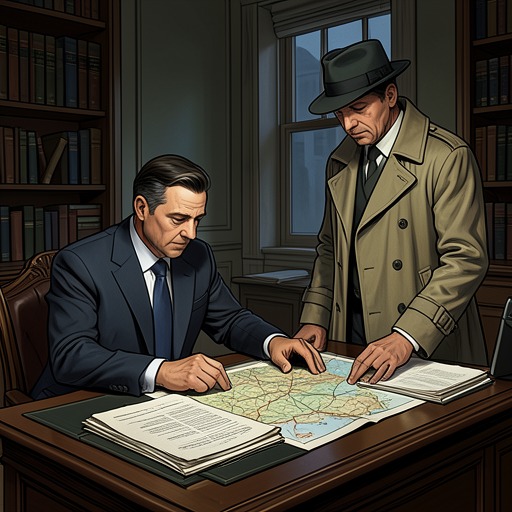
Sam Spade–Joel Cairo business relationship
The Maltese FalconThe business relationship between Sam Spade and Joel Cairo is a paid, conditional alliance formed around the recovery of a black bird. Cairo offers five thousand dollars on behalf of its rightful owner, and Spade accepts the assignment on stated terms: expenses during the search, the promised fee, and a commitment to recover the object honestly and lawfully. From the outset, however, Cairo withholds information, while Spade uses the pressure created by Cairo’s exposure to the recent killings to secure a more workable bargain. Their dealings show how the investigation is organized as much by money, guarded information, and shifting leverage as by the search itself.
The Commission and Its Terms
Cairo approaches Spade with an offer to recover a missing ornament, which he describes as a statuette depicting a black bird. He says he acts for the figure’s rightful owner and offers five thousand dollars, promising that no questions will be asked. The money makes the commission explicit, but Cairo’s careful language leaves the owner and the circumstances of the loss outside the agreement’s stated terms.
Spade does not accept the offer without clarifying what the money purchases. Once Cairo has gathered up his belongings, Spade confirms that Cairo will cover his expenses and pay five thousand dollars when the recovery is complete, less any money already advanced. Spade also insists that this is a legitimate proposition: Cairo is not hiring him to commit murder or burglary, but to recover the bird, if possible, honestly and lawfully. The exchange defines both the fee and the professional boundary Spade wants the client to recognize.
Information and Leverage
The arrangement is never an exchange between equals who disclose everything. When Cairo refuses to identify the man he is asking about, Spade argues that Cairo has tied himself strongly enough to the recent killings to suit the police. He tells Cairo that he must cooperate with him or face the alternative. Cairo, apparently prepared for Spade’s resistance, replies that he has made extensive inquiries and was assured Spade would be reasonable enough not to let other considerations interfere with profitable business relations.
Their disagreement over whether to reveal what each knows makes information a bargaining resource. Cairo refuses Spade’s suggestion that they put everything on the table: if Spade knows more, Cairo expects to profit from that knowledge, while Spade can still earn the agreed fee. Spade accepts the resulting imbalance rather than ending the commission. The terms are therefore practical but incomplete: Cairo can hire Spade without explaining the whole case, and Spade can pursue the object without accepting Cairo’s account as the whole truth.
A Client Among Competing Alliances
Cairo’s business connection with Spade intersects with Brigid O’Shaughnessy’s account of her own connection to Floyd Thursby. She says she met Thursby in the Orient, traveled with him from Hong Kong, and relied on him to help her, but alleges that he betrayed her while she depended on him. Her account gives Spade another strand of the case without resolving what happened or why, reinforcing the gap between the facts each participant chooses to disclose.
The competing claims over the bird become visible when Brigid asks Cairo how soon he can have the money ready for his own offer. Cairo says it is ready. The scene turns the object into the focus of overlapping negotiations rather than a straightforward recovery for a single, transparent client. Spade remains present as intermediary, but the bird’s prospective buyers and claimants have interests that do not automatically coincide with his paid assignment.
Cooperation Under Pressure
Cairo’s reliance on Spade is repeatedly disturbed by the presence of Wilmer Cook, whom Spade has shown Cairo. Cairo arrives agitated, reporting that Wilmer is watching the house and objecting that he had approached Spade in good faith, without expecting tricks or traps. Spade replies that Cairo was asked there in good faith, then recognizes that he should have anticipated Wilmer’s appearance. The episode makes plain that the commission cannot be separated from the surveillance and danger surrounding its participants.
When Spade later suggests talking somewhere else, Cairo refuses to continue their private conversations, explaining that their earlier encounters have given him no desire to do so. Spade answers that he had to side with Brigid when Cairo and she were in conflict: he does not know where the bird is, Cairo does not know, and Brigid does. His explanation frames cooperation with Brigid not as a change in the assignment’s objective but as a way of keeping access to the information he needs to fulfill it. He also tells Cairo to stay silent when Lieutenant Dundy questions him, warning that a sensible version of events would have placed them all in custody. The advice preserves Cairo’s safety and Spade’s room to maneuver, while making their working relationship dependent on a shared capacity to withhold and manage information.
Limits and Significance
The wider account of the bird’s journey confirms why no single participant controls the whole story. Spade reports that Brigid had given it to Captain Jacobi in Hong Kong to bring across on the La Paloma while she and others took a faster boat. Later, Casper Gutman says that he and his associates had not believed Thursby possessed the bird; they did not know at the time that Brigid had entrusted it to Jacobi. These facts place Cairo’s commission within a network of transfers and incomplete knowledge, not a simple client-and-detective search.
The relationship has a clear commercial core but no stable foundation of trust. Cairo pays for Spade’s services and expects him to act within a profitable business arrangement; Spade accepts the work, sets lawful limits, and presses for information when Cairo’s silence threatens the investigation. Yet Spade also negotiates with Brigid, responds to the threat around Cairo, and treats police scrutiny as a constraint on what they can safely say. Their association therefore helps drive the search while revealing its governing tension: the detective’s service is contractual, but progress depends on navigating rival interests whose knowledge, promises, and loyalties remain partial.